

Why Aluminum Shingle Roofs Are Best for Coastal Homes
Quick Answer
Aluminum is the best coastal roofing material because, unlike steel, it does not rust — it forms a stable, self-protecting oxide layer that shrugs off salt air. Interlock pairs that aluminum with a both-sides PVDF Alunar® coating, a four-way mechanical interlock for wind, and UL 2218 Class 4 impact resistance, so a coastal roof resists corrosion, hurricane-force wind, and wind-driven debris alike.
Salt air destroys ordinary roofs. Interlock's aircraft-grade aluminum shingles can't rust, are sealed in a marine-tough PVDF Alunar® coating, carry UL 2218 Class 4 impact resistance, and are Florida Building Code approved for High-Velocity Hurricane Zones — making them the best choice for coastal homes.
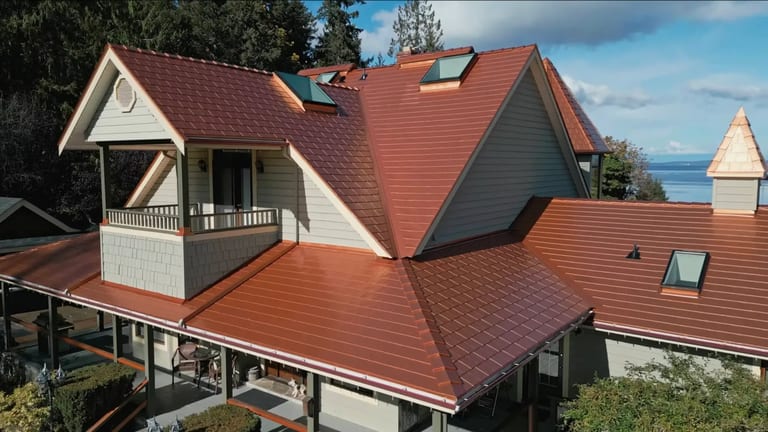
Nothing tests a roof like the ocean. Salt, wind, and wind-driven rain attack coastal homes around the clock — and most roofing materials simply aren't built for it. For a real-world look at how this plays out, see our case study on a Bremerton, Washington home that chose a roof that doesn't rust.
The biggest threat is corrosion. Steel roofing rusts the moment its coating is scratched or cut, and asphalt shingles dry out and blow off in salt-laden wind. Aluminum is fundamentally different: it forms a thin, stable oxide layer that protects the metal beneath, so it simply doesn't rust — which is exactly why aircraft and marine hardware are built from it.
Interlock builds its coastal-ready shingles from that same aircraft-grade aluminum, sealed on both sides in a PVDF Alunar® finish and locked together on all four sides. The result is a roof engineered for salt air, hurricane wind, and impact — and available in slate, shake, and shingle looks.
Interlock aluminum roofing is Florida Building Code approved (FL7263) for High-Velocity Hurricane Zones and rated UL 2218 Class 4 for impact.
Why is an aluminum shingle roof best for homes near the ocean?
Aluminum is the best coastal roofing material because, unlike steel, it does not rust — it forms a stable, self-protecting oxide layer that shrugs off salt air. Interlock pairs that aluminum with a both-sides PVDF Alunar® coating, a four-way mechanical interlock for wind, and UL 2218 Class 4 impact resistance, so a coastal roof resists corrosion, hurricane-force wind, and wind-driven debris alike.
Why Salt Air Destroys Ordinary Roofs
Coastal air carries microscopic salt particles that settle on every surface and accelerate corrosion. On a steel roof, any scratch, cut edge, or fastener penetration becomes a rust point that spreads under the coating. Asphalt shingles face a different but equally fatal problem: constant wind flexes them, salt and UV dry out the asphalt, and granules wash away until the mat cracks and lifts. Both materials are fighting a battle they eventually lose near the ocean.
Aluminum Doesn't Rust — It Self-Protects
Aluminum's advantage is chemistry, not coating. When exposed to air it instantly forms a thin, hard oxide layer that seals the surface and stops further corrosion — even if the metal is scratched. That's a fundamental material property, not a finish that can wear off, and it's why aluminum is the standard for boats, aircraft, and shoreline structures. Interlock uses alloy 3105-H24 and 3003-H24 (ASTM B209) and adds a both-sides PVDF Alunar® coating for color and extra protection.
"Chelsea, MA experiences coastal moisture and salt-laden air... metal shingles offer superior resistance to coastal moisture/salt spray and freeze–thaw damage, providing a durable roofing solution." — Ana Melecio, Chelsea, Massachusetts · Installed July 2015 · Verified GuildQuality review
Built for Hurricane-Force Wind
Corrosion isn't the only coastal threat — wind is. Interlock panels lock into each other on all four sides with concealed connections, so there's no exposed edge for wind to catch and peel, the way it lifts asphalt tabs. That interlocking design is why the system is Florida Building Code approved (product approval FL7263), including the state's High-Velocity Hurricane Zones — the most demanding wind standard in the U.S., and the same wind-resistant engineering we detail in our guide to 120 MPH-rated metal roofs.
Impact, Fire, and the Alunar® Finish
A coastal storm throws more than wind. Interlock aluminum shingles carry UL 2218 Class 4 impact resistance — the highest rating available — so they resist denting and perforation from wind-driven debris and hail. Aluminum is also naturally fire-resistant, achieving a Class A classification in tested assemblies. The Alunar® PVDF coating, applied to both faces, holds its color against relentless coastal UV.
Light Enough to Install Over Your Existing Roof
At roughly 0.41 psf, an Interlock aluminum shingle roof is a fraction of the weight of tile or even asphalt, so it adds almost no load to your home and can frequently be installed directly over the existing roof — avoiding a full tear-off and the landfill waste that comes with it.
The Coastal Verdict
For a home near the ocean, the material question answers itself: aluminum that can't rust, sealed in a marine-grade coating, locked against hurricane wind, and rated for impact and fire. Interlock backs all of it with the Guardian Lifetime Limited Warranty, transferable to the next owner.
Frequently Asked Questions
Will an aluminum shingle roof rust near the ocean?
No. Aluminum doesn't rust — it forms a stable oxide layer that protects itself even when scratched. That's why it's used on boats and aircraft, and why it outlasts steel and asphalt in salt air.
Can a metal roof survive a hurricane?
Interlock's four-way interlocking aluminum is Florida Building Code approved (FL7263) for High-Velocity Hurricane Zones — the toughest U.S. wind standard — with no exposed fasteners for wind to lift.
Are aluminum roofs energy efficient in coastal heat?
Yes. The Alunar® finish is independently tested with solar reflectance up to 0.55 and 0.84 thermal emittance, reflecting heat to help keep seaside homes cooler.
Is an aluminum roof too heavy for my home?
Just the opposite — at about 0.41 psf it's one of the lightest roofs available, adds virtually no structural load, and can often be installed over your existing roof.
Does it resist salt and wind-driven debris?
Yes. Aluminum resists salt corrosion by nature, and the panels carry UL 2218 Class 4 impact resistance — the highest rating — against wind-driven debris and hail.
Is it backed by a warranty on the coast?
Yes. Every Interlock roof carries the Guardian Lifetime Limited Warranty, which is nonprorated for the original owner and transferable once to a second owner for 50 years.
Explore Interlock Metal Roofing
Last updated June 9, 2026 · Reviewed for accuracy by the Interlock SEO Desk.